The rise of affordable housing in Uganda is completely reshaping how a new generation of buyers approaches the property market. Owning a dream home is a deeply personal milestone that almost every Ugandan genuinely desires. There is a distinct sense of pride in building security, planting roots, and investing in a space that is entirely your own. However, the moment you begin scouting for plots or scanning listings, that aspiration faces a steep reality check. Land prices are climbing aggressively, the cost of living is rising, and the financial gap between renting and owning keeps stretching wider. This collective national reality is exactly why the shift toward accessible, well-designed housing frameworks has become so essential.
Land Prices Are Rising Faster Than Most People Can Keep Up
According to the Uganda Bureau of Statistics (UBOS) Residential Property Price Index Report, residential property prices surged 9.2% in the year ending Q2 (Quarter 2) of the 2025/2026 financial year, nearly double the 4.7% growth recorded just a quarter before. Wakiso District, one of the most sought-after areas outside Kampala, saw prices jump 16.9% in that same period.
In Kampala’s prime neighbourhoods like Kololo and Nakasero, land starts at $50,000 and can easily exceed $1 million for a single plot. Even in outer suburbs like Kira and Najjera, prices range from UGX 1.6 million to UGX 2.8 million per square metre. For the average working family, this is not a market that feels welcoming.
Why Affordable Housing Is No Longer Optional
Uganda’s population is young, growing, and increasingly urban. Kampala’s population is projected to reach 7 million by 2035. More people are moving from rural areas to cities in search of work and opportunity. And with that movement comes an urgent, growing demand for housing that is both accessible and decent.
The result? A widening housing deficit that is pushing people to look beyond city centres to secondary suburbs and planned communities where land is still affordable and infrastructure is intentionally designed.
This shift is confirmed by The Africanvestor’s 2026 real estate analysis, which notes that the highest concentration of new developments is now in secondary suburbs like Kira, Kyanja, Naalya, Lubowa, and Munyonyo areas where developers are specifically targeting the growing middle class.
Affordable Does Not Mean Inferior
One of the biggest misconceptions in Uganda’s housing market is that affordability equals poor quality. That cutting costs means cutting corners. That a home you can actually afford must come with compromises on safety, design, or community.
This is simply not true and a growing number of developers are proving it.
True affordability is about smart resource allocation, deliberate spatial design, and building with people in mind, not just cutting budgets. It is about delivering homes that meet real structural and safety standards while remaining financially accessible to ordinary families.
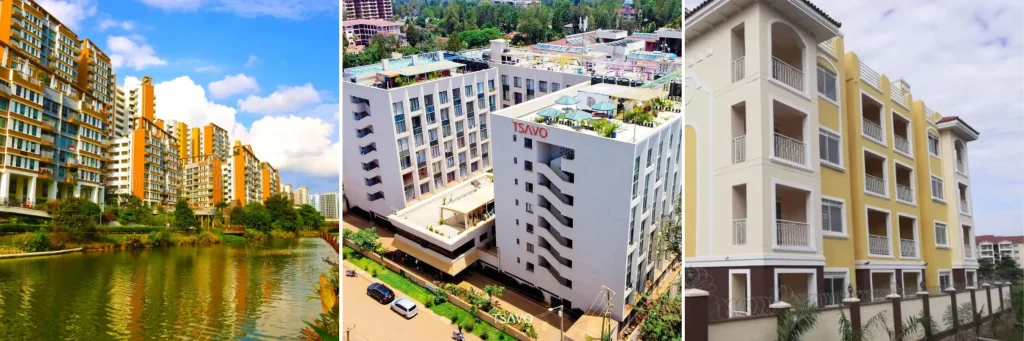
From Singapore’s iconic HDB model on the left, to Kenya’s modern Tsavo Real Estate project in the middle, and Uganda’s climate-smart Housing Finance Bank partnership on the right, these examples prove that intentional design and structured financing make quality housing achievable worldwide.
Globally Examples: Singapore’s Housing Development Board (HDB) is one of the world’s most cited success stories with 82% of its residents living in HDB-built homes, proving that quality and affordability can coexist at national scale. Vienna, Austria has kept housing accessible for over a century by treating it as a human right, not a commodity building planned communities designed by top architects for people of all income levels. Read more: Innovative Housing Solutions from Singapore and Vienna
Across Africa: Ethiopia’s Integrated Housing Development Programme (IHDP) has built over 400,000 housing units in Addis Ababa using a cost-sharing model that makes homes accessible to low and middle-income families. In Kenya, developers like GulfCap Africa and Tsavo Real Estate are delivering thousands of affordable units under the country’s Affordable Housing Programme targeting young, urban families priced out of city centres. Read more: Tackling the Housing Deficit in Africa | Top Affordable Housing Developers in Kenya
In Uganda: Locally, Housing Finance Bank and Easy Housing’s 2025 partnership is setting a new benchmark delivering climate-smart, incrementally buildable homes financed with up to 80% cover and competitive mortgage terms. The National Housing and Construction Company (NHCC) has also received USD 9 million from pan-African financier Shelter Afrique to construct new affordable units for low-income Ugandans. Read more: Housing Finance Bank & Easy Housing Partnership | Shelter Afrique & NHCC Uganda
The message across all of these examples is consistent: quality affordable housing is achievable when the developer is intentional about design, engineering, financing, and community from the very start.
How Quesi Properties Is Responding
For over six years, Quesi Properties has been building planned, secure, and accessible neighbourhoods in Uganda not as a luxury offering, but as a standard.
At Quesi, affordability is not a shortcut. It is a commitment. A commitment to design homes that work for real families, in communities where safety, dignity, and connection are built in, not added on. This evident in all our completed and upcoming projects ie:
- La Valle Estate in Kasanje
- Terra Vista Enclave in Kasanje
- Victoria Pearl Estate in Namulanda
- Emerald Golf Residence
- Domus Mpanja (Luxury Gated Community)
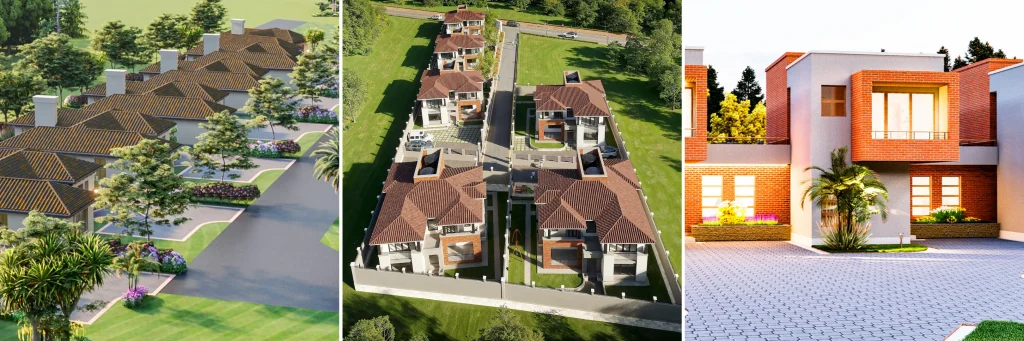
From L – R: The serene surroundings of La Valle Estate, Terra Vista Enclave, and luxury living of Domus Mpanja.
What makes Quesi different:
- Full-spectrum delivery. Quesi handles architecture, engineering, and construction under one roof eliminating coordination gaps, reducing costly errors, and giving homebuyers one accountable partner from concept to completion.
- Structured, milestone-based payments. Payment plans are tied to real construction stages concept planning, design, pre-construction, and procurement so buyers are never paying blindly.
- Planned communities, not just houses. Quesi developments are designed around how families actually live with smart layouts, natural light, shared green spaces, and proximity to schools, work, and essential services within a 20-minute radius.
- Diaspora-ready remote purchasing. For Ugandans abroad, Quesi offers fully digital documentation and verified title structures making it possible to invest in property back home without being physically present.
- A transparent buyer’s journey. From the first conversation to final handover, every step is communicated clearly. Watch how Quesi walks buyers through the entire process: Quesi Properties — The Buyer’s Journey to Affordable Homeownership
Whether you are buying into a Quesi development or building on land you already own, our promise is the same: quality housing, structured process, and peace of mind from start to finish.
The Future Belongs to the Planned
The data is clear. Land near Uganda’s urban centres will only get more expensive every year. The families who act with intention today, who choose planned communities over speculation, structured payments over waiting are the ones who will build real, lasting wealth.
Affordable quality housing is not a dream. It is a decision. And for Ugandan families, Quesi Properties is making that decision possible.
If you are ready to own your dream home without the stress of soaring land costs, Quesi Properties is here to help. We deliver high-quality, master-planned communities through flexible, milestone-based payment plans, email us at info@quesiproperties.com